From SDLC to ADLC: what changes when agents join the team
Agents can now write, test and review real code, but the lifecycle we built around people handing work to each other does not fit them. Here is the loop we run instead, and where people matter most.

Key takeaways
- The SDLC is a line built around hand-offs between people. Agents need clear intent and checks, not hand-offs.
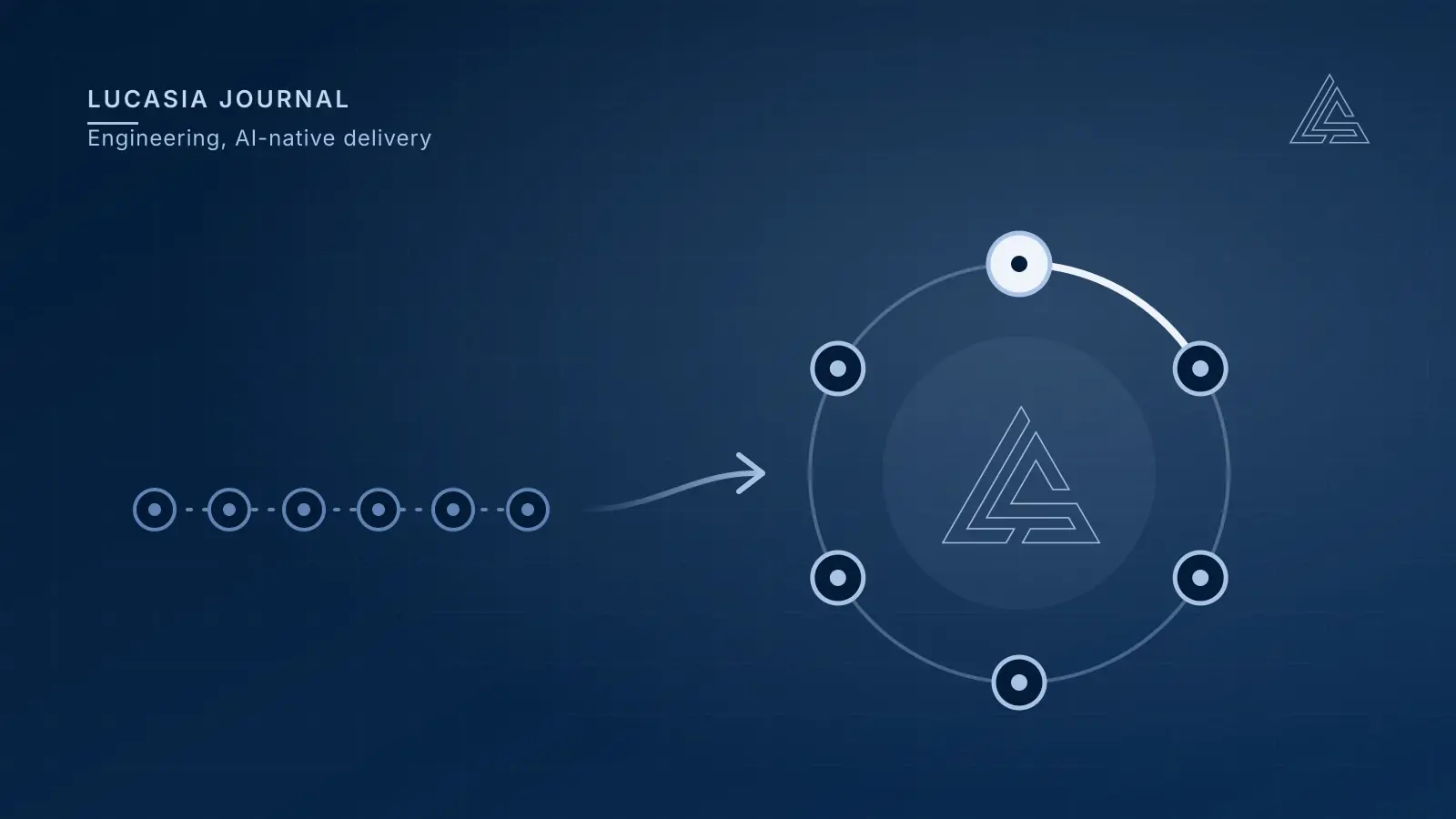
- The ADLC runs six stages in a loop, from captured intent to production signals that create the next intent.
- Written artefacts replace conversations as the hand-off, and together they form an audit trail.
- People set intent, make trade-offs, approve at gates and own the outcome. Agents do the heavy lifting in between.
For most of my career I have shipped software with some version of the Software Development Lifecycle. Requirements, design, build, test, release, monitor. It works, and it has paid my bills for a long time. But over the last two years agents have taken on a large share of the typing in our own work at Lucasia, and the lifecycle around them started to creak.
What surprised me was that the biggest change was not speed. It was shape. The SDLC is a line, built around people handing work to each other. Agents do not need hand-offs; they need clear intent, good context and checks they cannot talk their way past. So the line becomes a loop. We call it the ADLC, the Agentic Development Lifecycle, and this is how it works in practice. What is the ADLC? SDLC vs ADLC, side by side.
A line built for hand-offs
Look closely at the classic lifecycle and most of it is about moving work between people. An analyst writes requirements for an architect. The architect writes a design for developers. Developers hand a build to testers, who hand a release to operations. Every arrow is a queue, and every queue is a place where work waits and context leaks.
Those hand-off documents were written for humans who would fill the gaps with common sense, a chat at the coffee machine and a memory of the last project. Agents have none of that. Give an agent a vague ticket and it will fill the gaps with confident guesses. That is not a flaw to complain about; it is a design input.
What the ADLC is
The ADLC keeps the same underlying jobs, but arranges them as six stages in a loop that runs continuously. People set the intent and approve at the gates. Agents do the heavy lifting in between, always working from written artefacts rather than from memory. Select a stage to see what happens in it.
-
Capture intent
A person writes down what should change and why, in plain words: the problem, who it is for and what good looks like. This becomes a short intent file that every later step reads. It is the most important five minutes in the loop.
-
Requirements and design with an agent
An agent turns the intent into a specification and a plan, asking questions where the intent is unclear. A person reviews the plan before any code is written. Disagreements are cheap here and expensive later.
-
Agent builds with context and skills
Agents write the code and the tests together, using the project's own conventions, past decisions and approved skills. They work in isolated branches and cannot touch production, credentials or money.
-
Continuous evals
Every change runs through automated checks: unit and integration tests, type checks, accessibility scans and, for AI features, evaluations of the model's answers against known good examples. Failing checks send the work back, not forward.
-
Agentic review with executable gates
A second agent, often a different model, reviews the change against the intent and the plan. Then a person approves the merge. Gates are executable, so a rule like “no release without passing tests” cannot be skipped on a busy Friday.
-
Production signals create new intent
Errors, slow pages, support requests and usage patterns are collected and summarised. The useful ones become new intent, and the loop starts again. Every release teaches the next one.
Artefacts are the new hand-off
In the SDLC the hand-off is a conversation. In the ADLC it is a file. Intent, specification, plan, code with tests, review record and production notes all live in the repository, next to the code they explain. An agent picking up the work reads the same chain a new team member would.
That chain has a lovely side effect: it is an audit trail. For any line of code we can show why it exists, who asked for it, what was planned, which checks it passed and who approved it. Clients in regulated industries care a great deal about that, and so do we.
What this means if you are a client
You can ask “why did this change?” about anything we ship and get a real answer, with the intent, the plan and the approval behind it. Nothing depends on someone remembering a meeting.
Where the time goes
When people hear “agents” they picture faster typing. In my experience the bigger win is less waiting. Here is an example of how a modest feature might spend its time under each model. The numbers are illustrative, to show the shape, not a measurement of any one project.
Notice the last row goes up, not down. People spend more time on intent and approval, because that is where their judgement counts. The time comes out of queues and typing, not out of thinking.
What people do now
The question I get most from engineers is whether there is still a job for them. There is, and it is a better one. In the loop, people do four things that agents cannot do for them:
- Set intent. Decide what is worth building and what good looks like.
- Make trade-offs. Speed against cost, simplicity against flexibility, this quarter against next year.
- Approve at the gates. Read the plan, read the review, and say yes or not yet.
- Own the outcome. When something goes wrong in production, a named person is accountable, not a model.
Agents changed how fast we type. They did not change who is accountable.
Keeping it safe
A loop that runs continuously could also make mistakes continuously, so the safety rules are not optional extras. These are the ones we hold ourselves to:
- Least privilege. Agents work in isolated environments. They cannot reach production data, credentials or payment systems.
- Gates are code, not good intentions. Tests, type checks, security checks and accessibility scans run on every change and block anything that fails.
- People approve anything that matters. Merging, releasing, spending money and changing access all wait for a named person.
- Everything leaves a trail. Intent, plan, review and approval are written down, so we can explain any change months later.
How to start, if you run a team
You do not need to rebuild your process overnight. Start by writing intent down before work begins, even as three sentences in a ticket. Then automate one gate you currently do by hand, usually the test run. Then let an agent draft the plan for the next feature and review it together. Each step is useful on its own, and together they turn the line into a loop.
This is the way we deliver client work today, run by our own AI engineering platform. If you would like to see how it would fit your team, tell us how you ship today and we will show you, honestly, where the loop would help and where your current process is already fine.
Share this article